 |
| http://media-cache-ak0.pinimg.com/236x/7e/cb/b0/7ecbb08c32a7ef14bbba68aa5d6ca718.jpg |
Tuesday, December 2, 2014
Exiting the Story - Comp Tale Response 11
I can't say that I identify with these stories in the sense that I have experienced something similar, but I do see the necessity throughout these stories that the professor be open and willing to help the students. In tale 126, for example, the student that spoke fluent English, with terrible written English, would never have realized her ability to write perfect English if she connected it to her speech. Unfortunately, this student dropped the class (rather unexpectedly), but the fact remains that the teacher was there for her. A lot of these stories reflect professors altercations with students that seem a bit odd. As seen in tale 127, the student didn't want to discuss dropping the course, but then (after having a drop slip signed) ended up staying in the course and getting a low C--I'm assuming that's passing at this university. The point is, we will never really understand what students do, but as instructors, the only thing we can do is be there for them for support and guidance.

Tuesday, November 25, 2014
Assignments Smahshminements - Personal Comp Tale 11
So, I've been struggling to come up with my materials for next semester. I know what I'm doing, but I'm not sure I actually know what I'm doing (i.e. I know the subject matter, but have no idea how to implement that into a course). I've been thinking of ideas for assignments, but trying to think of constraints for students and making sure they stay within the assignment, etc. is just stressful. This process is interesting, but I'm not sure, until I have a lot of time to sit and actually focus on this, that I'll be able to come up with anything functional. What are some ways that you all have come up with ideas and implemented a theme?
I've been in classes that implement themes before, but I think that they were a bit different than the 104 set up (which has a lot to do with research).

I've been in classes that implement themes before, but I think that they were a bit different than the 104 set up (which has a lot to do with research).
Tuesday, November 18, 2014
Dynamic Criteria Map - Personal Comp Tale 10
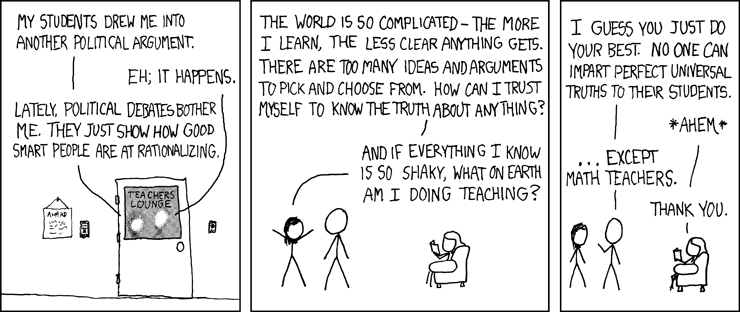
This is kind of a reflection on the Dynamic Criteria Map project, in a way, but it's different than what I wrote for my actual introduction paper. I suppose I just wanted to say, in a less formal way, that I was surprised how the values and beliefs of an instructor can be so deeply rooted in the assignments and syllabus. However, with my mentor, this was entirely intentional. So, for those of us just starting out, will our "values" and "beliefs" be intentional or just a haphazard mess? I think it's interesting to see how my values and beliefs align with B's and how I have a few things that I value on my own as well--obviously everyone is different, but it was really the similarities that surprised me. Great job MCF giving me a mentor that I can relate to! But really, this project helped me look at things a bit differently and I think that's important.
 |
| http://imgs.xkcd.com/comics/certainty.png |
Tuesday, November 11, 2014
Oh Captain, My Captain! - Personal Comp Tale 9
Now that I have finished teaching the unit in my mentor's class, I'm off to grading! But I think it's important to note that I really have enjoyed my time teaching. That's a good sign, right? I wasn't sure how I would respond to teaching comp (or something other than creative writing in general), but I found that I genuinely had a great time working with students and "molding young minds." And it was helpful that students told me they think I really found my place in teaching. One student said, "Yeah, before you started teaching, you just sat there quietly, but once you got in front of the class you had confidence and rocked it!" (He said this after his group came to my office hours). And as I've mentioned before, students have said that they thought I did great and that class was fun. So, fun is good, but I hope they actually learned something. We shall see if they did as I grade their papers. Muahaha. No, but seriously, it felt good to get that validation in this area of academia that I'm new to. And having a good observation (thanks N) helped as well. So, I guess what I'm getting at is, I like teaching and I seem to be decent at it, which is good news.
 |
| http://cdn2.hellogiggles.com/wp-content/uploads/2014/08/12/poet460.jpg |
Friday, November 7, 2014
Professionalism - Comp Tales Response 8
I immediately pulled out comp tale 92. This story enraged me in just the few short paragraphs written. I'm not sure what made me more angry, the fact that this GTA was demeaning his students (particularly by not fostering a good learning environment) or the fact that he was rude and demanding--they're both pretty terrible. I've worried about professionalism in my class--with cursing or how to dress--but never to this extreme. I've come to the conclusion that, especially as a GTA, there isn't much professionalism demanded from you, but it's still expected to some degree. So when do we cross that line of professionalism into being unprofessional? I think, especially since this is college, that we have a bit more leniency when it comes to teaching (i.e. jeans are okay on occasion, if you say "ass" the world won't crumble, etc). How much is too much though? I like to work as if every day is important to show my professionalism. I am, in fact, guiding students through their education and need to present myself in a way that they respect me (while also gaining respect from my peers).
tl;dr: Don't be a dick and act like a damn professional.
tl;dr: Don't be a dick and act like a damn professional.
 |
| http://rs1img.memecdn.com/unhelpful-highschool-teacher_o_445917.jpg |
Wednesday, November 5, 2014
Grading Papers - Personal Comp Tale 8
So, I've just received my first batch of rough draft papers. Looks like it's time to grade! I haven't yet looked at them, but this is a group paper, so I only have five. Although, I'm curious to see how evident their writing separate sections (if they did so and I'm assuming most of them did despite me telling them it won't work out that well) and smashing them together will be. I think what I'm most worried about is not being fair... or being too fair. Whatever the fairness, I want it to be just right. We were kind of talking about bias in grading in class and I don't think it will be an issue for this paper, but it is an interesting concept. How do we know that we're grading fairly and not being bias and grading off of our own opinions? Taking that step back in a necessity.
Thursday, October 30, 2014
I Am Writer - Comp Tales Response 7
I think, as writers, we often run into people thinking we have an easy job or they question our motives in conversation--or as Lubarsky puts it in tale 83, they have "a fear that I will critique each word they utter for the rest of the evening. I, for one, was tired of getting asked, "Oh... What are you going to do with that?" with a sympathetic facial expression, like my pet had just died, when stating I was studying for a degree in Creative Writing. I still get that question consistently. While I realize the job market sucks and it's hard to find exactly what we are looking for, I'm not sure why people deem it necessary to condemn us for choosing to work in a field that we love--I mean, I love what I do, I'm assuming most others do as well. So why do professors in other disciplines denounce composition and why do people in other fields think we're stupid for studying English, because there just has to be something better out there? This whole idea of "the public," and how they see us, as writers and academics in English, is frustrating, because everyone knows the importance of communication, but when it comes to studying writing it suddenly loses it's appeal. Do you not communicate by writing every single f#@&ing day?! Anyone--and by anyone, I mean people that can afford the technology which promotes said interactions, but even then, notebooks and pencils are a cheap form to write--who says otherwise is a liar.
So what is the difference between academic writing and all of the connotations that come with it and writing for pleasure? And why is it such a big deal?
So what is the difference between academic writing and all of the connotations that come with it and writing for pleasure? And why is it such a big deal?
 |
| http://upload.wikimedia.org/wikipedia/commons/4/41/Leonid_Pasternak_001.jpg |
Thursday, October 23, 2014
In Class Work - Personal Comp Tale 7
Yesterday I had the students do some in class work to find ONE source for their paper, however, one group sat there quietly and didn't do anything. I was walking around the class asking each group what they were searching for, if it was academic or popular, how it would be useful, etc. When I got to this group and asked if they had found a source, they looked at me with those half-smiles where they're considering lying to you about what they have done. Eventually one of them said they didn't look anything up. So I talked to them about what they could possibly look up. One student said that he wasn't clear about the expectations for sources--what they need is clearly spelled out on the assignment sheet and I noted it in class as well. So, I explained in further detail, but I'm not sure if that was to detract the attention from the fact that they didn't do their work or because he was genuinely confused. I don't want to think the worst of this student, but I didn't ask them for too much.
How do you deal with students not participating (or doing what you ask in general) in class?
How do you deal with students not participating (or doing what you ask in general) in class?
Thursday, October 16, 2014
Building Lesson Plans - Personal Comp Tale 6
I was worried that it would be extremely difficult to build a lesson plan--especially around rhet/comp ideas that can be difficult to explain and, if done incorrectly, very dry for the students. But I found that, not only did I have fun making lesson plans for my unit, the kids are seeming to enjoy them as well. I think what I was worried about most was creating this boring lesson that no one cared about, but getting good ideas for activities or ways to get students involved has been helpful. In fact, a student came up to me after class yesterday and told me that class was really fun and she thinks I'm doing well teaching--keep in mind this was only the second class I was teaching. That made me feel extremely good about what I am doing and gave me motivation to strive to be even better.
So what was my activity? Well, we were discussing finding a problem, solutions to that problem, and then selecting the best solution for this problem. I gave them the problem of "The Ball State Ass Slapper"--if you haven't heard of it, I have attached the news report. I could talk about the Ass Slapper for quite some time and all of the issues involved with it--like the fact that it got state-wide news coverage, yet we didn't get an email about an armed robbery that happened the day after this happened. I digress--but I had students get into groups of two and answer these questions of what the problem is, why is it a problem, what are solutions, etc. The group that had the best answer--and by best answer I mean the most ridiculous and made everyone laugh the most--would get to pick out the type of candy that the whole class will get (considering Halloween is nearing). What was the best solution, you ask? A butt bear-trap. Yes, that's right. A. Butt. Bear. Trap. I found that not only did this activity help them work through these questions and utilize the skills and see why it is important, but it also really lightened the mood. It felt good to break up the monotony of early morning classes with a bit of fun.
So what have been some of your best activities?
So what was my activity? Well, we were discussing finding a problem, solutions to that problem, and then selecting the best solution for this problem. I gave them the problem of "The Ball State Ass Slapper"--if you haven't heard of it, I have attached the news report. I could talk about the Ass Slapper for quite some time and all of the issues involved with it--like the fact that it got state-wide news coverage, yet we didn't get an email about an armed robbery that happened the day after this happened. I digress--but I had students get into groups of two and answer these questions of what the problem is, why is it a problem, what are solutions, etc. The group that had the best answer--and by best answer I mean the most ridiculous and made everyone laugh the most--would get to pick out the type of candy that the whole class will get (considering Halloween is nearing). What was the best solution, you ask? A butt bear-trap. Yes, that's right. A. Butt. Bear. Trap. I found that not only did this activity help them work through these questions and utilize the skills and see why it is important, but it also really lightened the mood. It felt good to break up the monotony of early morning classes with a bit of fun.
So what have been some of your best activities?
Tuesday, October 14, 2014
Phallic-ies - Comp Tales Response 6
I think the main message in tale 65 is that clarity is important. Miscommunication is a typical issue--I would imagine and have witnessed--in a teaching classroom. Obviously the way this is worded could drive a rowdy teen to talking about his penis. It's interesting what students think of when we say things like, "Think of a common object that is personally important." Where on Earth do you automatically think penis? Anyway, wording is important--that's what I'm trying to say. Get it? Got it? Good.
In a weird round-about way, I had this issue with a quiz question--yes, I gave them a quiz my first day teaching. Muahahaha. I worded a question, asking about things discussed in the chapter, in a way that students misunderstood. All but one of the students actually got it right. So, clearly I worded it wrong. I feel like this is unavoidable. In this instance I just gave them the point, but how can we avoid these situations as much as possible?
In a weird round-about way, I had this issue with a quiz question--yes, I gave them a quiz my first day teaching. Muahahaha. I worded a question, asking about things discussed in the chapter, in a way that students misunderstood. All but one of the students actually got it right. So, clearly I worded it wrong. I feel like this is unavoidable. In this instance I just gave them the point, but how can we avoid these situations as much as possible?
 |
| http://www.funnyjunk.com/funny_pictures/4742514/Misunderstanding |
Thursday, October 9, 2014
All right, kids, it is now my job to teach you... - Personal Comp Tale 5
I begin teaching on Monday! I'm excited to finally be in front of the classroom and test out my skills as a teacher--I've always felt like I would be good that this. My first three majors in undergrad were teaching majors, after all. I'll be teaching a group project (an ethnography), so this will be quite an interesting unit to jump start my time as an instructor.
I think my influence comes from teachers in high school and undergraduate course work (whether good or bad--mostly bad). It's always been a goal of mine to teach students in ways that would have helped me learn better in school. CLARITY is a huge thing. I never understood what a teacher meant--and being the introvert that I am, I never asked for clarification--so providing that clarity seems important. PROVIDING EXAMPLES is another tool. I learn best by doing, so seeing examples of what other students have done or what the instructor is looking for were always helpful. So, pulling from my own experience has always been motivation.
I'm wondering what got others interested in teaching--besides being required to do so for an assistantship (if applicable). What are some first-time/first-day teaching tips? I am here to be the best damn instructor I can be.
I think my influence comes from teachers in high school and undergraduate course work (whether good or bad--mostly bad). It's always been a goal of mine to teach students in ways that would have helped me learn better in school. CLARITY is a huge thing. I never understood what a teacher meant--and being the introvert that I am, I never asked for clarification--so providing that clarity seems important. PROVIDING EXAMPLES is another tool. I learn best by doing, so seeing examples of what other students have done or what the instructor is looking for were always helpful. So, pulling from my own experience has always been motivation.
I'm wondering what got others interested in teaching--besides being required to do so for an assistantship (if applicable). What are some first-time/first-day teaching tips? I am here to be the best damn instructor I can be.
 | |
|
Tuesday, October 7, 2014
Student Conferences?... I Guess Not - Personal Comp Tale 4
I have been with my mentor a few times over the course of the semester during his suggested office hours and during conferences. The immediate concern is, of course, the fact that most students just don't show up. I know we have talked in class about making these mandatory and having it count against attendance, but it's frustrating to know that students don't really take it seriously. I have seen students benefit greatly from these conferences and sometimes it is quite obvious that help would be beneficial.
It's the same for the Writing Center. Instructors suggest that you go, instructors suggest you attend office hours, etc. So how can we as instructors do more than suggest strongly? Making the Writing Center mandatory class wide is obviously not the best solution. I've thought that--after the first essay--if a student needs help writing, then making it mandatory on a case by case basis would be helpful. Giving the students that necessary push to see that the Writing Center isn't all that bad and, indeed, quite helpful.
So how can we fix this issue: guiding students that really need the help to these resources that would be incredibly helpful without making it mandatory or being forceful about it?
It's the same for the Writing Center. Instructors suggest that you go, instructors suggest you attend office hours, etc. So how can we as instructors do more than suggest strongly? Making the Writing Center mandatory class wide is obviously not the best solution. I've thought that--after the first essay--if a student needs help writing, then making it mandatory on a case by case basis would be helpful. Giving the students that necessary push to see that the Writing Center isn't all that bad and, indeed, quite helpful.
So how can we fix this issue: guiding students that really need the help to these resources that would be incredibly helpful without making it mandatory or being forceful about it?
Thursday, October 2, 2014
I Swear It's Spelled That Way - Comp Tales Response 5
In comp tale 51, Maria Knudtson has a student misspell "neurotic" as "necrotic," due to the fact that spell checker didn't catch the mistake. My mentor often tells students that Microsoft Word's spell checker is terrible and that they shouldn't rely on it so heavily. As Knudtson says, my mentor also says, to check their work--even after using spell check. I once had this issue when trying to write "conscious," I wrote "conscience." While it's easy to get these words confused--phonetically and definition-wise--I relied on spell checker to catch this error for me. And lo and behold, I was wrong.
I think technology gives students--well, everyone--this false sense of security. Thinking it will catch mistakes and tell you when a word or grammar is wrong is something you learn of years of using Word's spell checker as a crutch. While its rate of success is higher than its failure, it's extremely important to use, as Knudtson states, "their own knowledge of words... and they must proofread after they spell check" (65).
So how can we convince students that spell checker isn't all that it's cracked up to be? I, for one, think--beyond blatantly stating it--telling stories, such as my little slip up, has more of an impact. Not only that, but telling the students that grammar and spelling mistakes can affect their grade is always an important note.
I think technology gives students--well, everyone--this false sense of security. Thinking it will catch mistakes and tell you when a word or grammar is wrong is something you learn of years of using Word's spell checker as a crutch. While its rate of success is higher than its failure, it's extremely important to use, as Knudtson states, "their own knowledge of words... and they must proofread after they spell check" (65).
So how can we convince students that spell checker isn't all that it's cracked up to be? I, for one, think--beyond blatantly stating it--telling stories, such as my little slip up, has more of an impact. Not only that, but telling the students that grammar and spelling mistakes can affect their grade is always an important note.
Tuesday, September 30, 2014
Hey! I Know You. - Personal Comp Tale 3
I have seen students out of the classroom--while walking through halls or elsewhere on campus--and, having an authoritative position as a TA, the interactions are incredibly awkward. I wasn't sure whether or not to maintain the "authority" or to have a conversation with the student. Most of the time it's just a "Hi, how are you," type of conversation, but I'm always worried that students will try to socialize beyond my point of comfortability. Obviously it's easy to leave the conversation, but I'm afraid students will bring up social life and parties and situations that make me extremely uncomfortable. I suppose setting those boundaries could be as simple as saying, "I'd rather not discuss this..."
When I was an undergrad, there wasn't much conversation between professors and myself, especially outside of the classroom. While friendly, there wasn't much past a greeting--and occasionally small talk. I think part of the reason was my being uncomfortable in the situation. I didn't feel comfortable impeding on the professor's boundaries. I'm not sure if this how students would view a TA or instructor in general.
Seeing students out of the classroom tends to be an awkward interaction. Do you carry on a conversation or just say "hello"? Where would you draw the line?
When I was an undergrad, there wasn't much conversation between professors and myself, especially outside of the classroom. While friendly, there wasn't much past a greeting--and occasionally small talk. I think part of the reason was my being uncomfortable in the situation. I didn't feel comfortable impeding on the professor's boundaries. I'm not sure if this how students would view a TA or instructor in general.
Seeing students out of the classroom tends to be an awkward interaction. Do you carry on a conversation or just say "hello"? Where would you draw the line?
Thursday, September 25, 2014
Grading Papers - Comp Tales Response 4
In comp tale 42, the instructor didn't have time, with their daily life, to grade papers. So, instead of being honest with the students, they returned the papers saying they were the worst they had ever seen. While this may be unethical, they said the revised papers were the best they had ever seen. So this brings up the question. If you are swamped and cannot grade the papers in a timely manner, what is the best thing to do? While this instructor had a good outcome, I'd say that this strategy is not the best way to go about a situation such as this. I would imagine that telling the students that you're incredibly busy and will return them as soon as possible. That is more honest and ethical than returning them and telling the to rewrite to buy you some time. I've had instructors tell me before that they are incredibly busy and they're sorry it is taking so long. In these instances, I understood completely and didn't get angry or judge them for taking the time they needed.
So what are the best ways to cope with having a ton of your own work to do while also having a ton of students' work to grade?
So what are the best ways to cope with having a ton of your own work to do while also having a ton of students' work to grade?
Monday, September 22, 2014
Uh, I don't know? - Comp Tales Response 3
In tale 19, Don Cunningham explains his conversation with students pertaining to lettuce. Somehow they began talking about collective nouns. So what is a collective noun? A collective noun is a noun, as herd, jury, or clergy, that appears singular in formal shape, but denotes a group of persons or objects. But my question isn't whether or not lettuce is a collective noun--it seems to me that it would be when talking about a head of lettuce, as stated by the student--it's what do you do in a situation in which you don't know the question or a student takes control of the conversation?
Yet another thing that a new teacher, such as myself, is worried about is not knowing the answer to a question. I feel this way especially, because I don't have a background of rhet comp. In fact, it was what I loathed the most in high school and early years of undergrad. So naturally, teaching this subject seems a bit daunting, considering I didn't start paying attention until my junior and senior years of college, and even then I didn't get much experience. So, how would one handle a situation in which a student asked this kind of question? Cunningham states that he was trying to regain control of the class. How difficult would this be? From what we have discussed thus far, it seems that being honest and saying you don't know the answer is the best way to handle this. I think that's what I would do if I came to this situation--which seems inevitable, really. Maybe being honest would get everything back on track.
And I think we can all agree that we'd be glad Mary wasn't in that class, as he was glad his advisers weren't in his.
Yet another thing that a new teacher, such as myself, is worried about is not knowing the answer to a question. I feel this way especially, because I don't have a background of rhet comp. In fact, it was what I loathed the most in high school and early years of undergrad. So naturally, teaching this subject seems a bit daunting, considering I didn't start paying attention until my junior and senior years of college, and even then I didn't get much experience. So, how would one handle a situation in which a student asked this kind of question? Cunningham states that he was trying to regain control of the class. How difficult would this be? From what we have discussed thus far, it seems that being honest and saying you don't know the answer is the best way to handle this. I think that's what I would do if I came to this situation--which seems inevitable, really. Maybe being honest would get everything back on track.
And I think we can all agree that we'd be glad Mary wasn't in that class, as he was glad his advisers weren't in his.
Thursday, September 18, 2014
What's Your Name Again? - Personal Comp Tale 2
One of the things I've been struggling with is getting to know students' names. It's more difficult when you're not the instructor and are doing less grading, etc. But it is obviously important to know the students despite that. I have handed back papers and talked to some students throughout the past month and I only know a handful of them by name. This makes me feel disingenuous and frankly kind of dumb. Not only that, but it can be misconstrued as disrespectful. "Oh, you know their name, but not mine?"
What made me think of this was a recent instance in which a student called another student by the wrong name. I'm not sure if this student's response was a joke, but they seemed to be genuinely upset, "My name is ____. It's not ____, or ____ or ____... etc... It's ____." (This student has a name with a lot of "similar" terms that could be used). In that instance, it was kind of funny--only because of the terminology used--but I realized that by not knowing a student's name, I was essentially doing the same thing.
How long does it normally take to remember anyone's name, let alone 25-50? I think being more hands on will definitely help with getting to know students better. But how, as mentees, do we do that? Is that something we shouldn't worry about until we are actually in front of a class? What is the best way to prevent this?
What made me think of this was a recent instance in which a student called another student by the wrong name. I'm not sure if this student's response was a joke, but they seemed to be genuinely upset, "My name is ____. It's not ____, or ____ or ____... etc... It's ____." (This student has a name with a lot of "similar" terms that could be used). In that instance, it was kind of funny--only because of the terminology used--but I realized that by not knowing a student's name, I was essentially doing the same thing.
How long does it normally take to remember anyone's name, let alone 25-50? I think being more hands on will definitely help with getting to know students better. But how, as mentees, do we do that? Is that something we shouldn't worry about until we are actually in front of a class? What is the best way to prevent this?
Tuesday, September 16, 2014
Misspeaking - Comp Tales Response 2
As a new TA, I felt like one of the most terrifying things an instructor could encounter would be misspeaking--terrifying internally that is, obviously there are some more prominent external threats. In a world full of Freudian-slips, it seems nearly impossible not to misspeak. So when one says, "slip your dick in," instead of, "slip your disk in," what happens? Besides the obvious silence. And how do you maintain authority? I for one would struggle keeping my composure--because let's face it, it's a funny slip up. Wheeler states, in her comment, that she finally laughed and the "pressure was off," but not only that, "the incident became kind of a bond between" the instructor and the students. I think it is important to know when keeping composure would be more beneficial than detrimental. It could have simply been a story that the students told their friends, "Yeah, my English teacher totally said, 'slip the dick in,' today in class. She just stood there in silence like a goon." Either way it would live on through stories, but sharing that moment with students seems to have been important to this instructor. It made a teachable moment.
So, should we be afraid of misspeaking? No. We say things wrong sometimes. So what? I think acknowledging the mistake makes us more human. The authority still maintains even with a slip-up.
So, should we be afraid of misspeaking? No. We say things wrong sometimes. So what? I think acknowledging the mistake makes us more human. The authority still maintains even with a slip-up.
Thursday, September 11, 2014
Social Media - Personal Comp Tale 1
Within these first few weeks of classes, the one thing I have worried about is students adding me on social media. There are things in the media (e.g. movies, magazine articles, etc.) that portray this relationship between instructor and student as acceptable or okay. And while a professional relationship with a student is acceptable, there are boundaries that must not be crossed. As a young adult starting college, I think it is hard for them to distinguish the line of appropriate conduct--with all of their excitement and freedom. The instructor is a professional in the college classroom. Developing a personal friendship, as opposed to a professional relationship, with students is nearing unethical territory, especially when it comes to conflict of interest.
I have had one student try to add me on various social media sites. This has made me extremely uncomfortable, not only because of the unethical nature, but also because of the perceptions this could convey. Also, when the students found out that they couldn't make appointments with me in the writing center, they seemed upset--I'm assuming it's because I know the assignments. Both of these instances make me question how the students view my authority in the classroom. While I'm not their instructor, I'm not a peer either. And obviously at one point I will be instructing the course.
So how do we, as instructors, move passed these interactions with students while still remaining professional? I think it is important to establish your authority within the classroom, but what are the best ways to go about doing this?
Monday, September 8, 2014
Judgment - Comp Tales Response 1
In response to Tale 1 from Chapter 1 of Comp Tales, I think judgement is the biggest ethical issue one can face as an instructor. When we look at a student who may have a questionable past (e.g. time in prison), it is important not to let that information cloud our perception of said student. We are not in a position to judge those who are from a different background. Each student deserves our encouragement and confidence, despite anything. Our duty is to teach those to the best of our ability. When we make generalizations, such as the common portrayal of community college and their lack of prestige, we undermine the education that the faculty at these institutions is providing and the quality of students that attend them.
Avoiding judgement is essential to building a solid foundation as an instructor. Composing "writing assignments" and forming "responses which acknowledge and invite students to make use of rather than dismiss or undercut interests, knowledge, and expertise they bring to the classroom" is an important strategy to implement, especially as new educators (Haswell 9). Applying this lesson, we can see that building a classroom free of judgement gives it the potential to include all students, while also avoiding animosity or conflict.
Works Cited
Avoiding judgement is essential to building a solid foundation as an instructor. Composing "writing assignments" and forming "responses which acknowledge and invite students to make use of rather than dismiss or undercut interests, knowledge, and expertise they bring to the classroom" is an important strategy to implement, especially as new educators (Haswell 9). Applying this lesson, we can see that building a classroom free of judgement gives it the potential to include all students, while also avoiding animosity or conflict.
Works Cited
Haswell, Richard H., and Min-Zhan Lu. Comp Tales: An Introduction to College Composition through Its Stories. New York: Pearson Longman, 2008. Print.
Subscribe to:
Posts (Atom)